
April Fools 2025: Phone books and adverts
I am a big fan of doing silly things seriously. Going through with a plan fully, where the motivation is pretty much “because I can” is a blast. They make people laugh. Most April Fools “jokes” are quite terrible in that regard, generally just an announcement to then say “Ho ho, April Fools!” — and the audience goes mild. Real jokes take some effort, and make everyone laugh in the end. They can be silly, or slightly satirical, but they are not mean. Luckily they also exist — every year Google Japan used to bring out a keyboard video, like this one for example (see https://yt.be/keyboards for a full list):
This year I also decided to take some effort and make some of my silly ideas real (and hopefully cause a smile in the process). Actually, I had some silly ideas that happened to surface again just before April Fools. Had they happened another time of the year, I’d have done them regardless, just that now there was a good reason to get them done before a certain time.
Ad Fund ‘Em
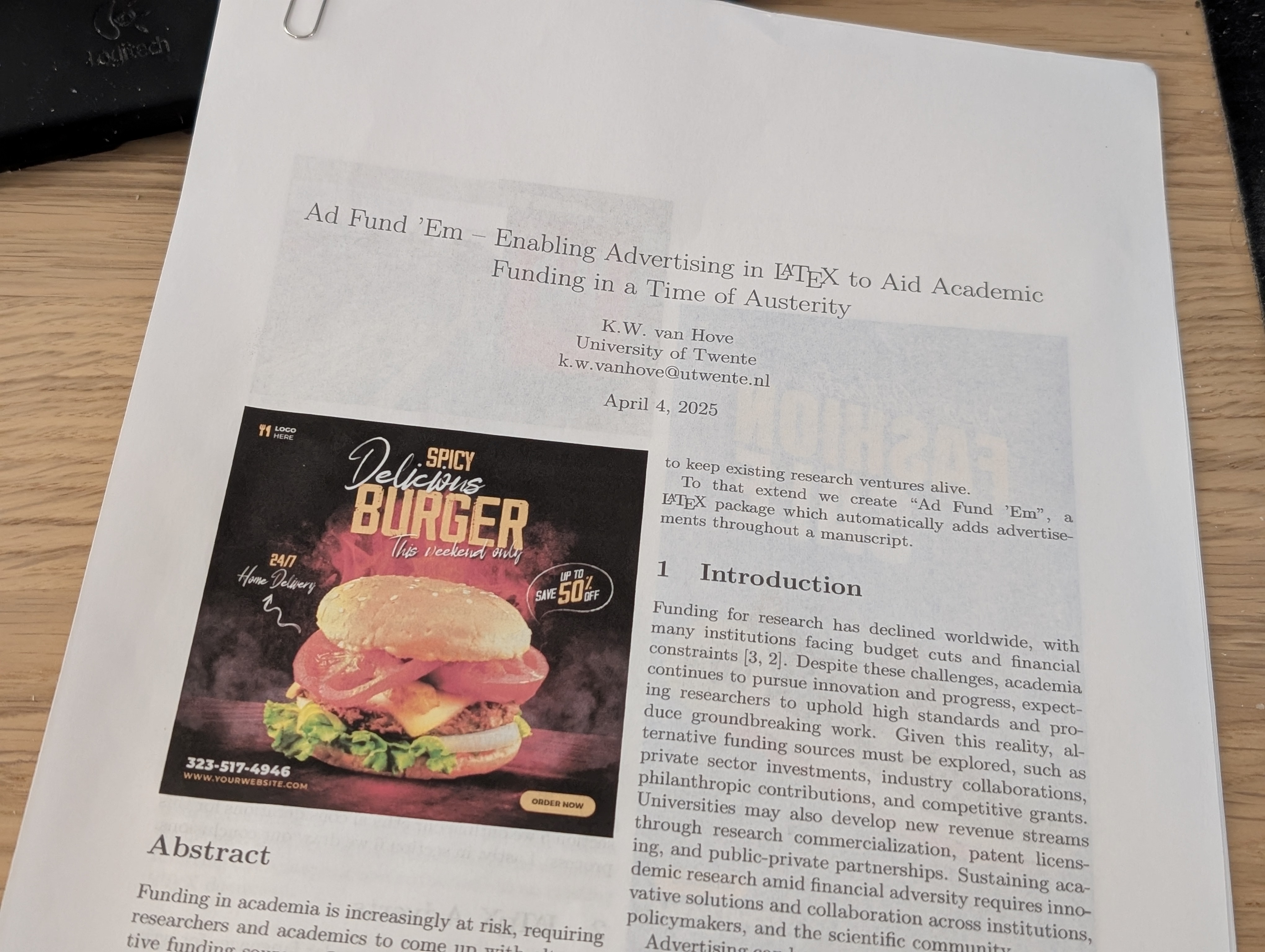
The idea for this was one that I had some years ago. During a discussion about funding for academia, I jokingly suggested adding adverts to research papers. After all, the internet is littered with them (but not this blog!). That was received very well, but never made it past the “funny idea” phase. Recently funding in academia came under threat even more, which triggered this idea again. It slightly critiques the current stance (I don’t think the funding cuts are a great idea, especially in the current manner), and also comments on the ubiquitous nature of adverts in current public space. It’s also just funny.
Additionally, SIGBOVIK was coming up. SIGBOVIK is a conference I have loved for a long time, and admittedly consider one of the highlights of the year. It’s a conference held around April 1st organised by computer science students of Carnegie Mellon University. It is a satirical take on academia and academic conferences and publishing. The most important part is that people do things you would never get published in a real journal, as every reviewer would ask “… but why?”. It is silly ideas done seriously, serious ideas done silly, and everything in between.
Given that I had had this curiosity on how to make LaTeX packages anyway, and the fact that I had time, I decided to just give it a go. Of course every scientific paper needs a name, and I quickly came up with Ad Fund ‘Em, a pun on Ad fundum, which in student life means “drinking an entire glass of beer (or other alcohol) at one time”. I don’t drink, but I couldn’t let a good pun go to waste.
The result can be found here or in the proceedings on page 99. Making the package itself went rather smoothly, and the responses I got afterwards were all what I was hoping for: people were both amused and horrified. One of the fun things about writing something like this is that I can slightly let the academic rigour slack, and add remarks in figures that offer no real value other than bringing a smile to the reader. I often have these thoughts when writing actual scientific work as well, but then I keep them to myself.
DialNS redux
I have already written about DialNS earlier, so this was not a new idea. However, as I was making the paper submission for SIGBOVIK, I realised I might as well re-record DialNS and submit it as a presentation. Where’s Ad Fund ‘Em does not work in presentation form, DialNS does not really work in text.
I submitted it to SIGBOVIK, and then I waited for the conference to come around. Most other years they had a livestream from the room at Carnegie Mellon University (generally the quality was not great, but hey). I sent an email beforehand if there would be one this year as well, but I received no reply. When the conference came around, there was no livestream. That was a real let-down — I assume my submission was shown, but I have no idea whether it was, or how the audience reacted to it. That feels really strange.
At least some strangers on the internet found it — presumably because they, like me, were looking for any footage from SIGBOVIK 2025 on the internet (at that point I was not even sure it had taken place). All positive reactions. You might also spot a subtle reference to my SIGBOVIK paper laying on top of the printer: that was not coincidence :-) Apart from that it did not take much work to record: the video limit was 3 minutes, and most of the humour is the functional-yet-inefficient method of doing this via the phone, so apart from the opening I had not much to prepare. You can still call it yourself at the moment of writing (May 2025): +31 85 369 5573.
Phone book of the Internet
The saying “the DNS is the phone book of the internet” is one I have heard many, many times already. It is not difficult to see how that would translate into turning it into a real book. A few weeks before April Fools the idea came up again (although I do not quite remember how, though probably related to DialNS). My mind started thinking about how I could actually do it. Ideally I would make a Dutch phone book, but the .nl zone is sadly not open, so that was not possible (let alone the size it would be — it would be about a metre thick).
For my actual research, I had been using the Cloudflare Radar dataset of top 1,000,000 most resolved domain names (according to Cloudflare’s own public resolver, 1.1.1.1). This was a good enough list of domain names to use for this silly idea as well. I set about thinking about how I was going to resolve all those 1,000,000 domain names (my simple sequential Python scripts would not work for that), but when discussing it with a colleague he mentioned that OpenINTEL probably has that data. That would make things a lot easier, plus, you know, it is a project where I know the people working on it. A quick look, and he was right. Additionally, it allowed me to find out how to work with parquet files (which I had never done before) — it is remarkably simple in Python to load those into a Pandas DataFrame.
The format I wanted was quite simple: left aligned domain name, right aligned IP address, and something in between to fill the space. I based this on images I could find from old phone books, which were surprisingly difficult to find online. Though to be fair, there generally does not seem to be a good reason to photograph the content of a phone book. I based myself on pictures like this. Initially I had the plan to use HTML, and then turn the HTML into a PDF (similarly to how I printed 252 pacenote booklets). However, I was not pleased with the result I got, and using more columns in print in HTML with CSS was a mess. I also made a text-based version, where I calculated the amount of dots necessary to fill the space between the domain name and IP address, but real phone books were not using monospace characters (at least not in Europe), so it felt “off” to have that here.
I quickly decided to use LaTeX. I have a love-hate relationship with LaTeX: it’s slow, the syntax is awful to work with if you try to do anything special with the formatting, but the end result looks incredibly pretty. I would have to generate most LaTeX code, and that I did with some good old fashioned Python string replacement. I tried something out, went to compile it, and compiler out of memory. Oh. I have learned a lot about the memory management of the three different LaTeX compilers (pdflatex, xelatex, and lualatex) I have on my machine. Some more fiddling and I got a version working that compiled. The LaTeX to make this work is not pretty, but it works and that’s what counts in print. Some more tinkering, making sure the fonts are correct (I do really like Inter, especially when it’s small print), and I had a layout I was happy with. I also discarded all domain names that do not fit on the line together with their IP address, because dealing with overflowing columns was not on the list of things I wanted to deal with.
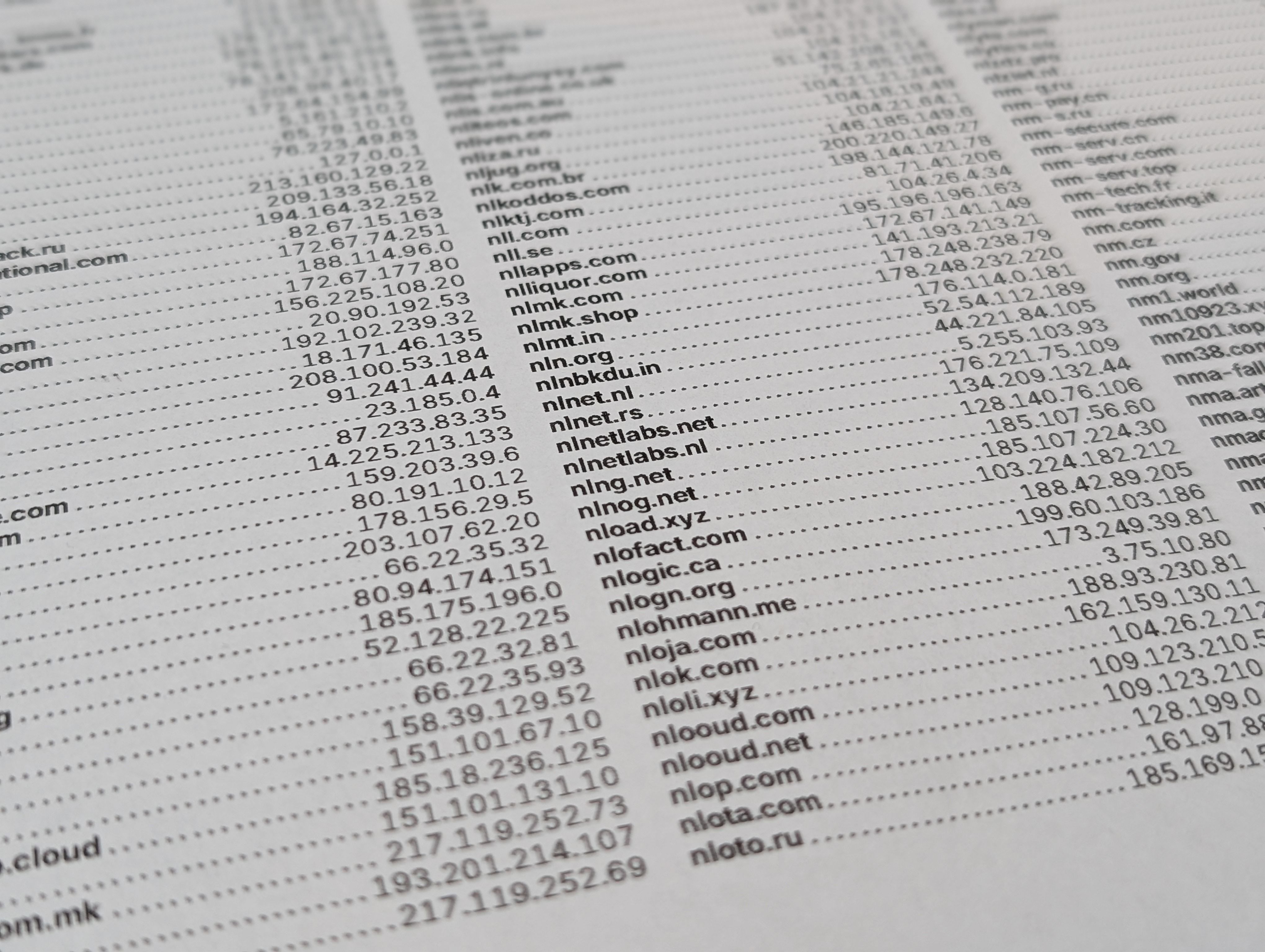
Initially I had every new letter start wherever it wanted in the column. It was just a large section header. This worked fine, except compile times went up to around 5 hours, which was a bit more than I wanted. A colleague suggested compiling every letter separately and in parallel, and then including the PDF back into the original. It felt like a hack, so I did that, and it worked marvellously. I also got to use all my 32 cores in my laptop for once. A side-effect was that now every letter started on a new page, not that that was an issue.
April Fools was getting closer, and when I showed at work what I had done on April Fools itself, they were so enthusiastic that we decided to turn it into a work thing. Article written, picture made, PDF online. It got far more attention than I expected — turns out seeing your own domain name among thousands of other domain names is quite popular. Many comments about how funny it was, the puns, also DialNS got some more attention again (because I added it to the article).
One comment I got a lot was about the lack of IPv6 support. I can show you why it only uses IPv4:

Another comment that popped up quite often was “I’d buy a book if you made one”. That did not sound like a bad idea, so strengthened by the many positive comments, I went looking on the internet how much it would cost to get it printed. I sent an email to a printed that claimed it could print the original ~3200 page version, after a week I got the reply that they could, but that they generally only do up to 800 pages. A bummer, but understandable (even more so after I received the actual physical version, it’s heavy enough). I reduced it to the top 200,000 domain names, which reduced it to 602 pages. The price also dropped significantly to just over €20 (instead of ~€80), which was a price I was willing to do this for.
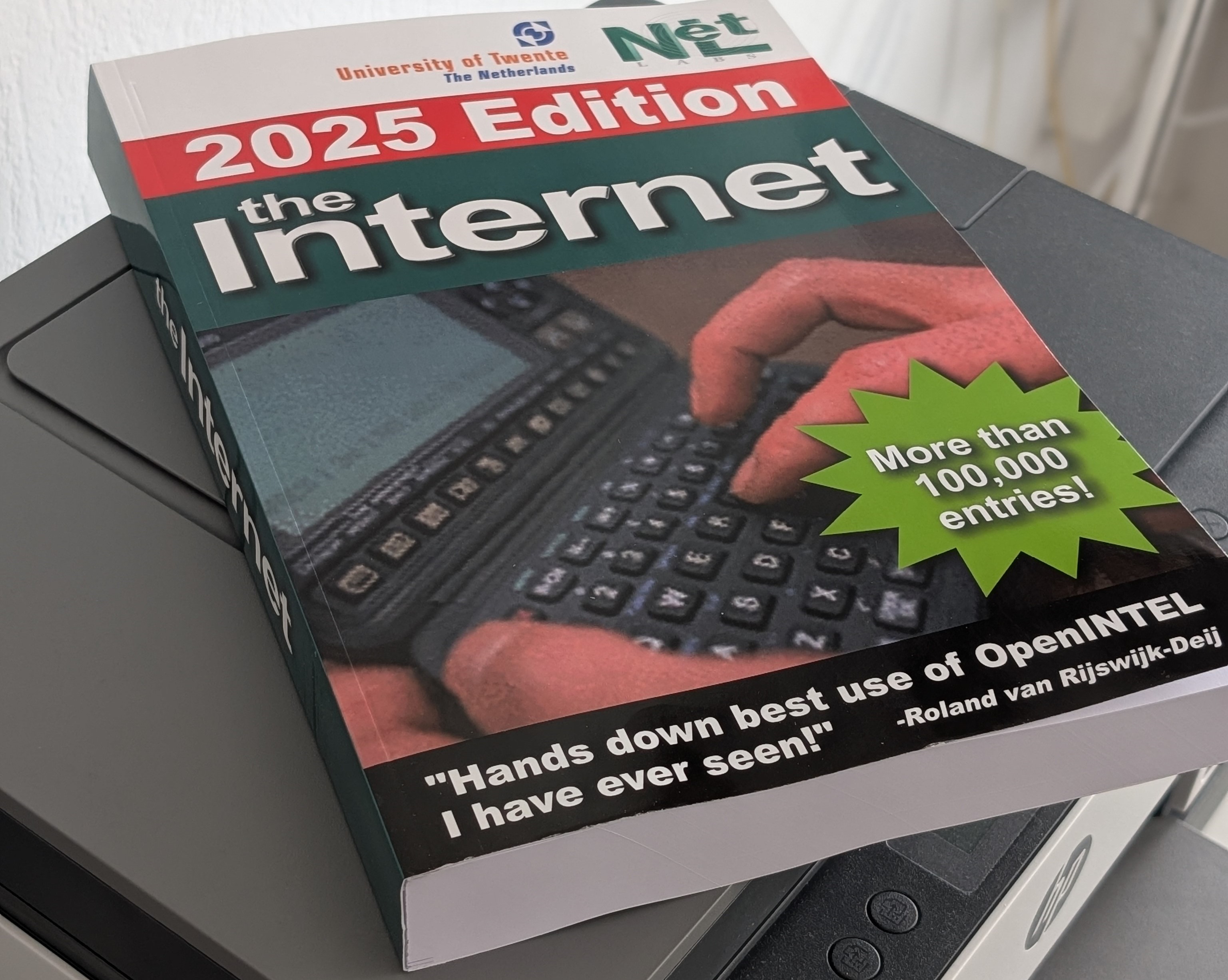
The most work was designing a cover. I wanted it to look like a book about the internet from the 90s or early 2000s. I used this picture of the Internet Yellow Pages from 1996 for a lot of my inspiration, as well as similar “Internet” books from the same era. I installed Microsoft Publisher 2003 to get period correct images for the front and back. The quote on the front was provided without asking by my university supervisor (and one of the founders of OpenINTEL) Roland — thanks Roland!
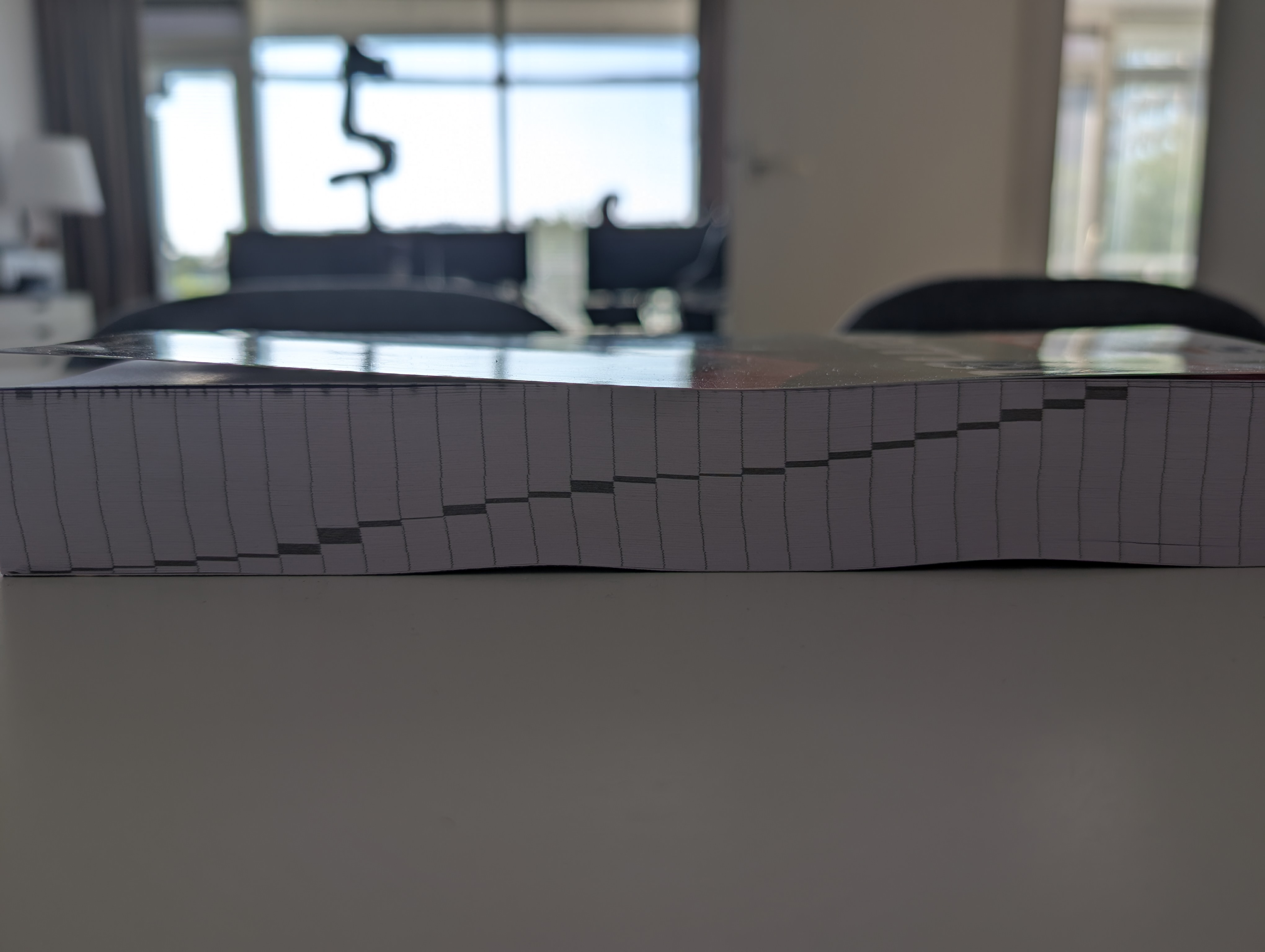
Another things that took quite a bit of work was making the tabs on the side work. I wanted the “which letter are you at now” style tabs that you had in the phone book back in the day as well. I found some LaTeX things online that created tabs, and with some bodging I managed to make it work. Again, the LaTeX code looks horrible, but the end result is pretty, and that’s what matters. A nice side-effect (that I did not account for) is that you can see the thickness of each section on the side of the book:
I had already found the printer I wanted to use. Their systems were sadly a bit slow, especially if you are playing around with things. It would often take hours before their automated system would tell me whether the file I had provided was correct.
I also found that they had a button to request an ISBN, and that free of charge. That was an opportunity I could not let pass — so yes, this book has an ISBN: 978-9-46-511631-0 to be precise. I looked up whether that meant I now had to use a fixed book price, but that’s only for Dutch and Frisian works, and this one is technically English due to the title page. A relief, otherwise I would have had to register this book at the Commissariaat voor de Media.
I was finally happy with the way it looked, I ordered one, and then I waited for it to arrive. It was both shipped later and delayed, which was quite annoying. I expected it to be delivered in my letter box, but the book is too thick to fit. It was a lot bigger and heavier than I anticipated, even though I knew the dimensions. It only really dawns on you when you have it in hand. Of course every first print contains a mistake — this one was no different. I had made the tabs slightly too close to the edge. According to their documentation it should be within the margins, but it was not. Of course I took it to the office, and my colleagues thought the books was very funny as well. I ordered one for Roland too, and a few other friends and colleagues now have one as well. I also added the buy link online. That’s not me trying to sell you this, just saying that if you want one, you can buy one. The source files are also available, if you prefer that option.
All in all this year was a very busy April Fools. One that was a lot of fun for me and others. I think I accomplished the goal I initially set out of making people smile. I don’t have any plans for next year, but I am sure I will be able to come up with something.